


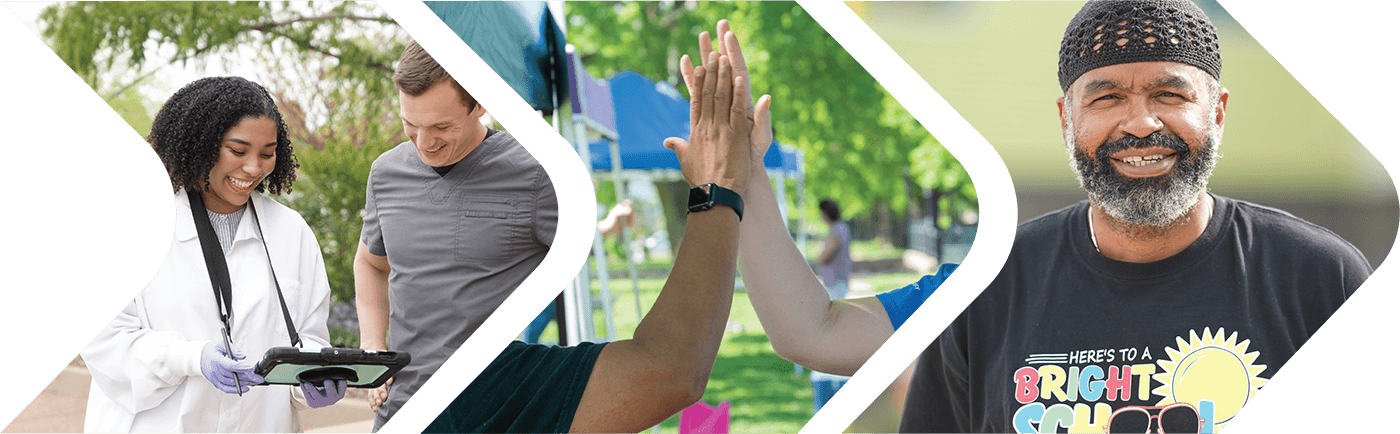
The Roadmap for Community Engagement was developed based on experiences using a community-engaged approach to distribute more than 2 million free at-home COVID-19 test kits across three U.S. communities in 2021. It includes insights from community members, scientists, project leaders, and health communicators. Each section will provide an overview of what you can find in those chapters. You can download those sections or the entire Roadmap and a Glossary listing terms used in all the chapters using the buttons below.
Watch a replay of the live webinar Unveiling the Roadmap
We are eager for your feedback on ways to improve this Roadmap going forward.
|
The Roadmap is a tool to support effective collaboration and community partnerships to promote the co-design of public health and research programs. Community partners know their area’s needs best and can give valuable advice about running a successful program. This guide can help at any stage, but it is particularly useful in early planning. Establishing partnerships early allows for the best chance to build a collaborative program. |
| In This Section | Tools, Templates & Resources |
|---|---|
|
1.1 About the Roadmap |
Compass for Project Planning |
| Community-engaged research addresses ways to promote health and well-being by working collaboratively with community members on public health research programs. Once the program has identified shared values and priorities, community-engaged research follows a general structure with seven key phases. |
| In This Section | Tools, Templates & Resources |
|---|---|
|
2.1 Community engaged health research FAQs |
|
Public health programs aim to improve community health and well-being, but their impact should last beyond their initial implementation. Designing a sustainable program ensures that the program’s benefits continue even after funding or resources are no longer available. Sustainable program design starts with understanding community needs and aligning program goals with local priorities. Groups can then design programs to be flexible, allowing adjustments based on feedback and expansion. |
| In This Section | Tools, Templates & Resources |
|---|---|
|
3.1 Building a program to last |
| Understanding local dynamics can help build strong community relationships. Communities can build trust through transparency with community leaders, especially in marginalized communities. They can also develop program goals and evaluation metrics with program partners and use these to track progress. And finally, communities can plan data collection strategies that consider participant privacy and timelines. |
| In This Section | Tools, Templates & Resources |
|---|---|
|
4.1 Partnering with a Community (phase 1) |
|
| There are several steps to ensure a successful project launch such as a new partner onboarding process to understand program goals and expectations. It may also include developing clear guidelines for supply distribution and resupply and pairing programs with existing community engagement events. Finally, it's important to establish key metrics and a plan to gather feedback to adapt. |
| In This Section | Tools, Templates & Resources |
|---|---|
|
5.1 Orienting Community Partners |
| Reflecting on the program’s successes and challenges is crucial for improving future public health programs. Once the program is over, evaluate its success by reviewing the metrics established in the planning phase. |
| In This Section | Tools, Templates & Resources |
|---|---|
|
6.1 Thanking Partners |
Acknowledging our Partners
This Roadmap was developed in partnership with Pitt County Health Department, Greenville, North Carolina and United Way of Merced County, Merced, California.